

“Mathematics is the sacred thread weaving together nature and spirit, revealing the intricate patterns of life and the infinite wisdom of the cosmos. Through its symmetry and order, we glimpse the divine rhythm that unites all existence.”
Curriculum Vision
Children flourish and succeed as they develop a
deep and lasting understanding of mathematical patterns, procedures and concepts.
Maths is instrumental in solving real-world problems and is a universal language that surpasses cultural and linguistic barriers. It provides a foundational framework for understanding the world.
As a department we reject the idea that a large proportion of people ‘just can’t do maths’. By maintaining a mindset of positivity we encourage all students and members of the St Hilda’s community to see making a mistake as an opportunity to learn and develop. The intent of our mathematics curriculum is to be accessible to all, maximising the development of every student’s ability and academic achievement. We provide challenge and the opportunity to deepen understanding of key mathematical ideas, whilst encouraging our students to be resilient and creative in their approaches to solving problems.
We want children to make rich connections across mathematical ideas and to develop fluency and mathematical reasoning, whilst confidently and independently developing the skills to solve problems of increasing complexity.
As our students progress, we intend for them to be able to understand the world through the eyes of a mathematician and have an appreciation of the beauty and power of mathematics. We encourage students to enjoy and be curious whilst developing a sense of awe and wonder.
Curriculum and Assessment Maps
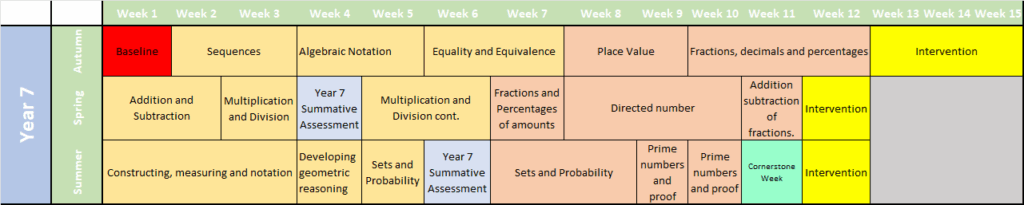
YEAR 7
YEAR 8

YEAR 9

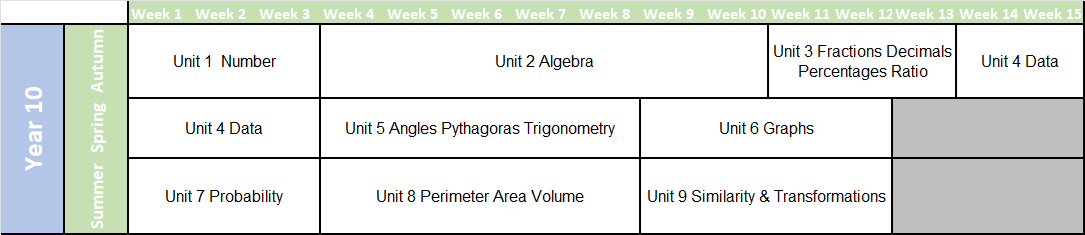
YEAR 10
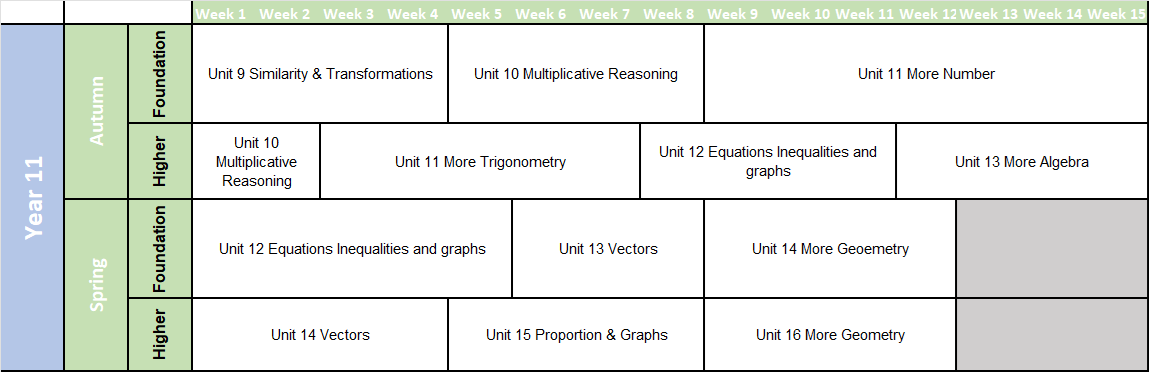
YEAR 11
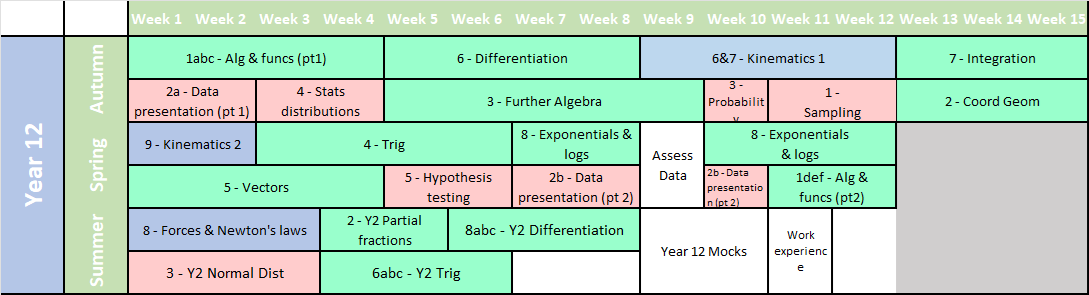
YEAR 12
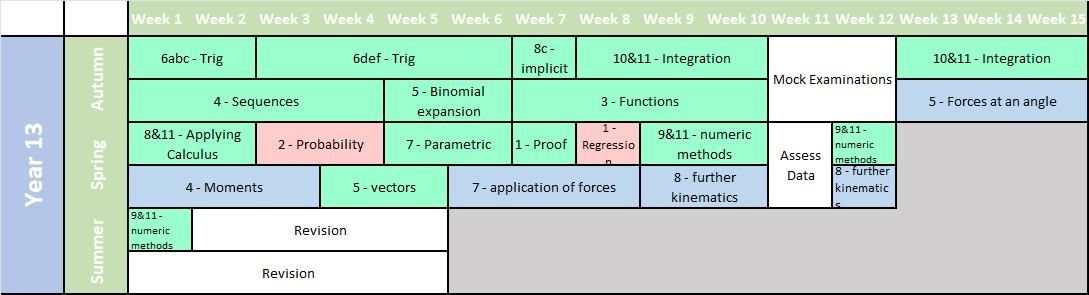
YEAR 13
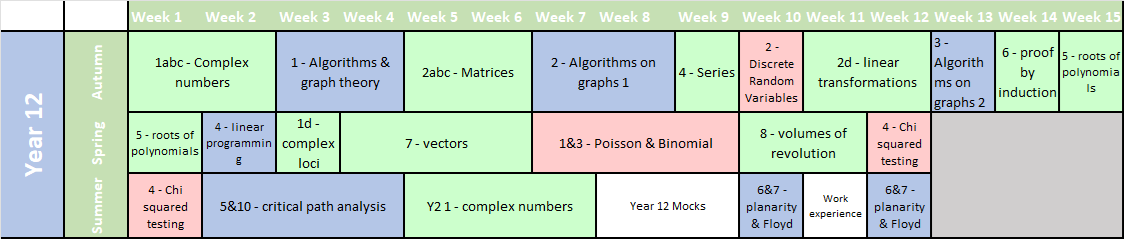
Further Maths
YEAR 12
YEAR 13

Further Information
STAFF
The Mathematics Department consists of the following staff:
Mrs E Hanton (Head of Department)
Mrs J Weaver (Teacher in charge of KS4)
Mrs M Murray (Teacher in charge of KS5)
Mr G Walsh
Ms K Harrison
Ms K Rigby
Mr S O’Rourke
Mr S Critchley
Mr L Foster
Mrs C Dadswell
Mrs E Cowdell
The department has eleven Teachers of Mathematics, one of whom holds responsibility as an Assistant Head and one of whom holds responsibility of a Head of House. All work together extremely well as a team and are very supportive to the Head of Department. Under the direction of the Head of Department members share responsibility for the progress of students throughout Key Stage 3, Key Stage 4 and St Hilda’s College.
ADDITIONAL INFORMATION
Key Stage 3
At Key Stage 3 students are broadly grouped by ability. The Mathematics Department follows the White Rose Mathematics scheme in line with the National Curriculum. All the pupils follow the same scheme of work and are tested on a regular basis throughout the year via a range of formative assessment and summative end of unit tests.
All KS3 students have access to SPARXMaths which they are directed to use for homework and additional independent practise.
Key Stage 4
At Key Stage 4 the scheme of work is based on the content of the Edexcel GCSE Maths specification. Students are assessed via a range of formative summative tests. The results from the summative tests and the end of year examination are used in the setting process.
Students are taught in ability sets with each set covering the same scheme of work during Year 10. The lower sets have a smaller number of students so they are able to receive more individual help where necessary.
All students take the same tests throughout the year and the same end of year examination. These papers will be of the style of the GCSE papers and contain GCSE questions. The results from year 10 are used to adjust the setting for Year 11. It is departmental policy not to make unnecessary changes to the teaching groups at this time as continuity with the same member of staff is considered to be important, however changes in sets will be made if it is deemed to be beneficial to the student.
All KS4 students have access to SPARXMaths which they are directed to use for homework and additional independent practise.
Sixth Form
Mathematics is an increasingly popular option in St Hilda’s College. Students follow the Edexcel Specifications for both Mathematics and Further Mathematics A Level. There are two teaching groups who study Mathematics in Year 12 and one in Year 13.
Students are encouraged to follow a structured personal study schedule to help them utilise their study periods.
All KS5 students have a unique login to the Integral online resource where they can access a wide range of videos, additional notes and examples, crucial points, additional exercises and online tests for each topic in the course.
https://my.integralmaths.org/login/index.php
Results in both A Level Mathematics and Further Mathematics are consistently excellent.
Rooming/Resources.
The Department has seven teaching rooms. All rooms have an interactive whiteboard. All students in St Hilda’s College who study mathematics are supported to purchase their own graphical calculator for individual use.
HOW CAN PARENTS HELP?
Show interest and encourage your child to talk about the unit which they are currently studying.
Whenever possible, encourage your child to:
Act upon teacher feedback.
Review their work frequently.
Use SPARXMaths and suggested website links to consolidate classroom learning.
Make revision materials at the end of each topic.
Speak to their class teacher if further explanations or help is needed.
Attend Maths clinic that runs weekly.
At GCSE and A level, work through lots of past papers before the examinations and carefully read the mark schemes and examiner’s report.
Make use of the revision materials on the curriculum website.
At A Level follow the structured personal study schedule
WHERE NEXT
The department has enjoyed a great deal of success at GCSE and A Level. Results have been excellent and consistent over a number of years at all levels with a number of students choosing to study Mathematics or Mathematics related courses at university.
Mathematics can open the door to some very exciting degree courses and careers.
Mathematics apprenticeships:
Payroll Administrator – Level 3
Actuarial technician – Level 4
Financial services administrator- Level 3 (equivalent to A levels at grades A to E). Typical length:12 months
Assistant Accountant – Level 3
Workplace Pensions (administrator or consultant) – Level 3
Financial Services professional – Level 6
Mathematics careers:
Accounting technician
Actuary
Air traffic controller
Architect
Artificial intelligence (AI) engineer
Automotive engineer
Bank manager
Civil engineer
Credit controller
Data analyst-statistician
Data scientist
Database administrator
Economist
Finance officer
Financial adviser
Insurance underwriter
Investment analyst
Meteorologist
Stockbroker
Tax adviser
Students looking for further careers advice whilst studying Mathematics at A Level can get information regarding different career paths, university admissions and other student views on studying maths by reading the latest edition of SUMs magazine here:
https://amsp.org.uk/sums-steps-to-university-for-mathematical-students/