

“The heart of the discerning acquires knowledge, for the ears of the wise seek it out.” – Proverbs 18:15
Curriculum Vision
Children have a natural curiosity for nature and it is our job as members of Team Science to enhance and sustain this by showing that science provides an understanding of the exciting physical, chemical and biological worlds around them. As specialist Science teachers, our purpose is to motivate, inspire and empower our pupils so that they will become responsible and educated ‘St Hilda’s scientists’ who will hold the future of the Earth and its resources in their safe hands.
We aim to show how scientific advancement has the power to save lives and benefit the global community but also that there is a responsibility to use science wisely and not destructively.
As effective role models, Science teachers can also show that science qualifications can open the door to many rewarding careers in STEM and the wider world. Progression in learning is most effectively accomplished if the teacher has the responsibility for organising and facilitating learning. We have a firm subject knowledge and pedagogical foundation from which we can plan and deliver lessons that are engaging and challenging to all pupils.
Curriculum and Assessment Maps
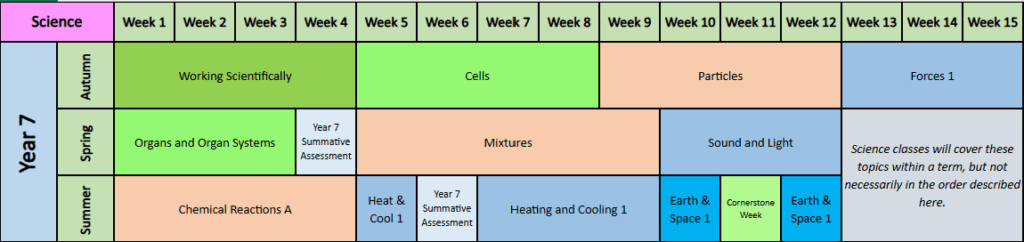
YEAR 7
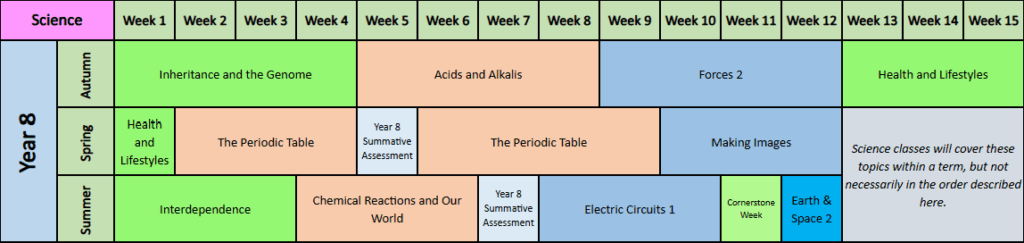
YEAR 8
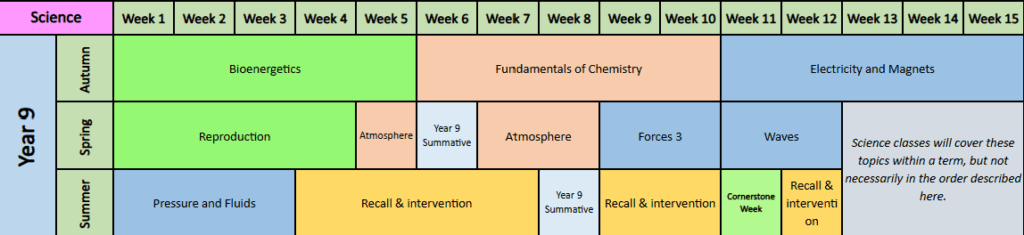
YEAR 9
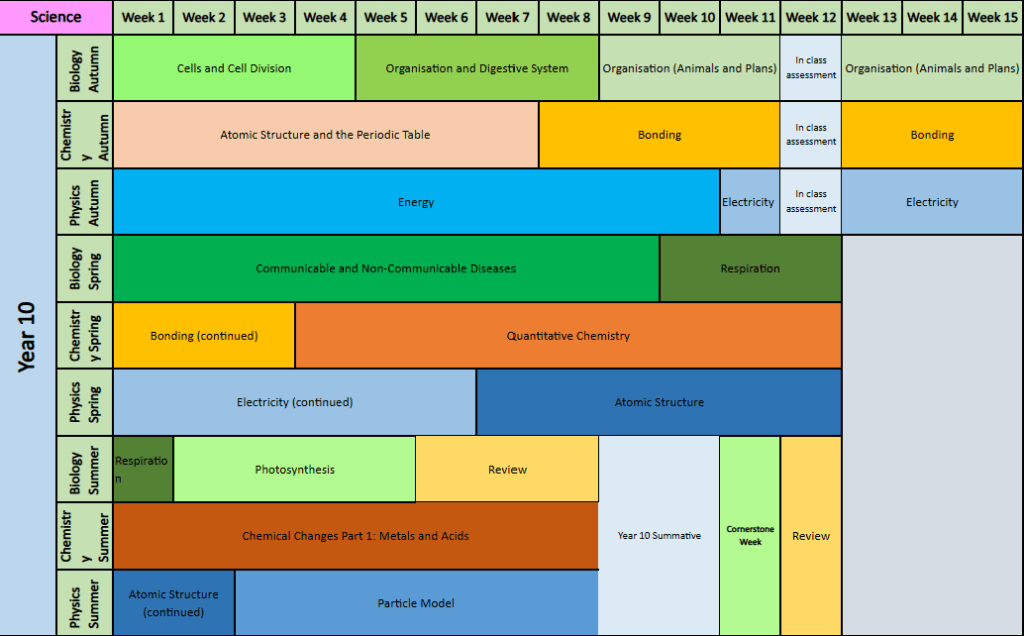
YEAR 10
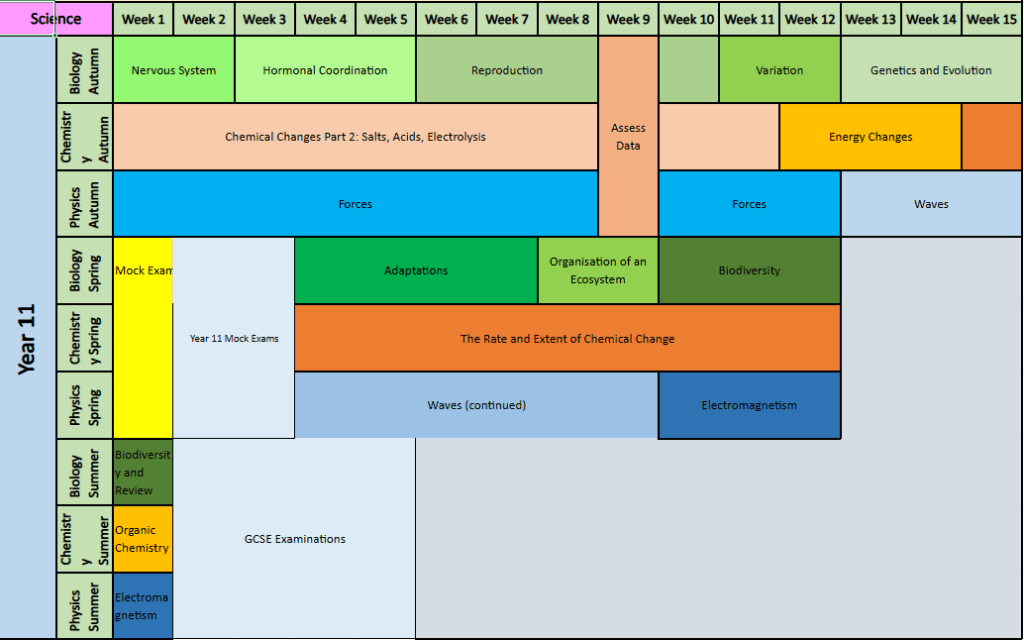
YEAR 11
YEAR 12 and 13
A-Level Biology is delivered according to the AQA Biology course
https://www.aqa.org.uk/subjects/biology/a-level/biology-7402/specification
A-Level Chemistry is delivered according to the AQA Chemistry course
https://www.aqa.org.uk/subjects/chemistry/a-level/chemistry-7405/specification
A-Level Physics is delivered according to the Edexcel Physics course
https://qualifications.pearson.com/en/qualifications/edexcel-a-levels/physics-2015.html
BTEC Applied Science is delivered according to the Pearson AAQ course
https://qualifications.pearson.com/en/qualifications/btec-nationals/applied-science-aaq.html
Further Information
STAFF
Further Information
Staff
The Science Department consists of the following staff:
Mr A Macaulay (Head of Department)
Ms R Edwards (Teacher in charge of Biology)
Dr Meredith (Teacher in charge of Chemistry)
Ms R Toher (Teacher in charge of Physics)
Mrs E Maher
Ms S McGowan
Ms E Higgs
Mr D Cain
Mr C Phillips
Mr D Goodrum
Mrs L Williams
The department has eleven Teachers of Science, one of whom holds responsibility as an Assistant Head of College and one of whom holds responsibility as a Head of House. All work together extremely well as a team and are very supportive to the Head of Department. Under the direction of the Head of Department members share responsibility for the progress of students throughout Key Stage 3, Key Stage 4 and St Hilda’s College.
HOW CAN PARENTS HELP?
Encouraging your child to:
- Read the teacher comments and where relevant act on them.
- Reflect on assessments to enable them to identify how to improve.
- Use revision materials, such as Carousel Learning, at the end of each topic
- Review their work frequently
- Use the student portal to consolidate classroom learning and read ahead to be ready for new topics
- Explain their learning from lessons to you or their siblings
Watch science related programmes (e.g., Bang Goes The Theory, Brainiac, Horizon).
There is lots of Biology on television: any of the Attenborough programmes, Channel 4’s Inside Nature’s Giants, some of the Horizon programmes.
Radio 4’s “Material World” is great too – and available as a podcast!
Read scientific literature. This is available in the school library, science articles in newspapers or on the BBC News website.
WHERE NEXT
Beyond the obvious and fiercely competitive medicine & dentistry there are the popular and still highly demanding courses like pharmacology, optometry and audiology. An A-level in Physics can lead to a variety of courses at university such as Geophysics, Architecture, Computer Science, Finance and Economics, Materials Science etc. as well as the more traditional routes into Astronomy and Engineering.
Biology has many aspects which can all provide degrees and job opportunities. Consider zoology, applied biology, sports science, agriculture, physiology, forestry, neuroscience, ecology, and marine biology. Then there are the many biochemical aspects – biochemistry, genetics, food scientists, pathology, histology, bio-physics, bio-engineering and the like.
One possibly appealing aspect of studying Science at university is the diversity of careers, which are not set in any one direction. Many Scientists end up using their skills in their work, but many gain other positions in industry through their ability to interpret and communicate well and the literacy, numeracy and graphical skills developed whilst studying Science.
Science graduates have skills that are in high demand in diverse sectors. These include skills relating to numeracy, problem-solving, data analysis and the communication of complex ideas, as well as a wider understanding of how the world works, on a scientific and human level.
Science graduates are in demand in many industries such as research, education, finance, automotive and aerospace industries, defence, the public sector, healthcare, energy, materials, technology, computing and IT, meteorology.