
Curriculum Vision
We believe that a high-quality cultural education in every school should be a right, not a privilege. As a department we must encourage young people to be inquisitive, disciplined and determined; wherever children start in life. Alongside literacy and numeracy, another skill needed in our workforce today is creativity. Cultural education subjects help young people to unlock their innate creativity, enabling them to become more rounded and confident human beings.
All students at St Hilda’s CE High School will have the opportunity to use a range of materials, techniques and processes including sculpture, printmaking, textiles, digital technologies, drawing and painting media. Most Art lessons focus on practical tasks which allow students to gain knowledge and skills from these new experiences. The department are also committed to providing students with experiences outside of the school, such as competitions and trips.
We recognise all students are on a journey with their learning and aim for all students to have the confidence to evaluate their learning and set targets for the future, in relation to relevant career paths.
Curriculum and Assessment Maps
YEAR 7
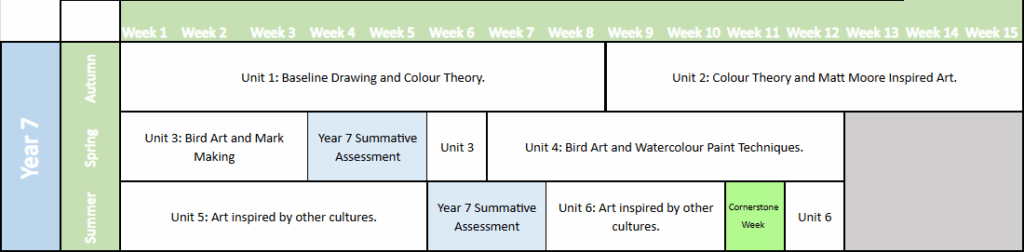
YEAR 8
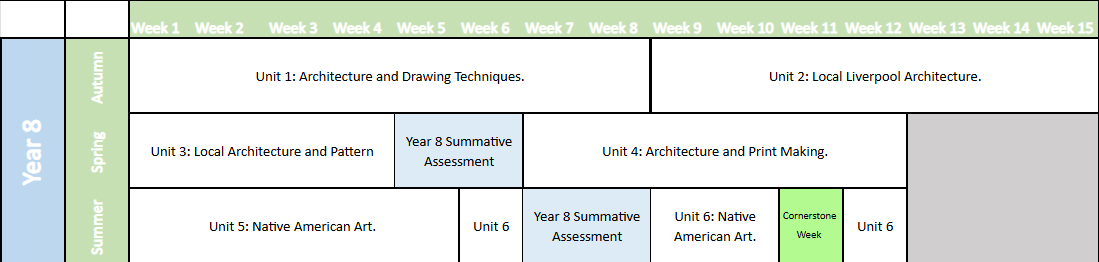
YEAR 9
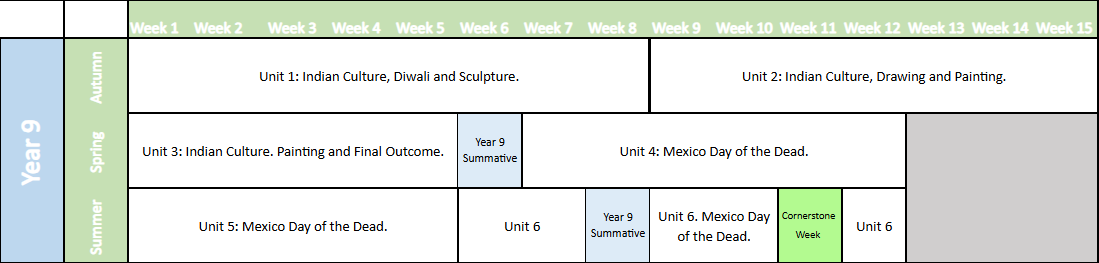
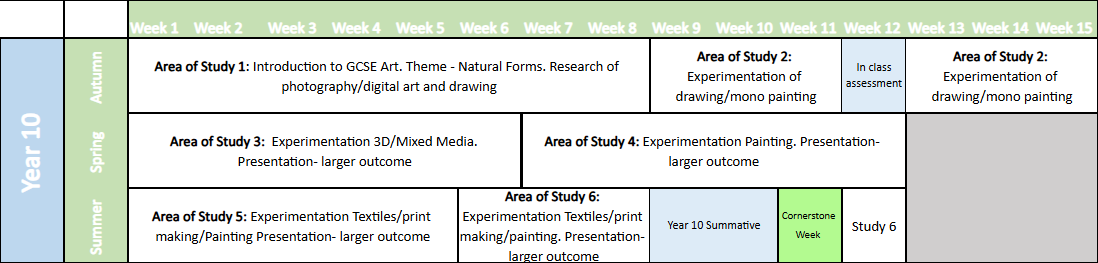
YEAR 10
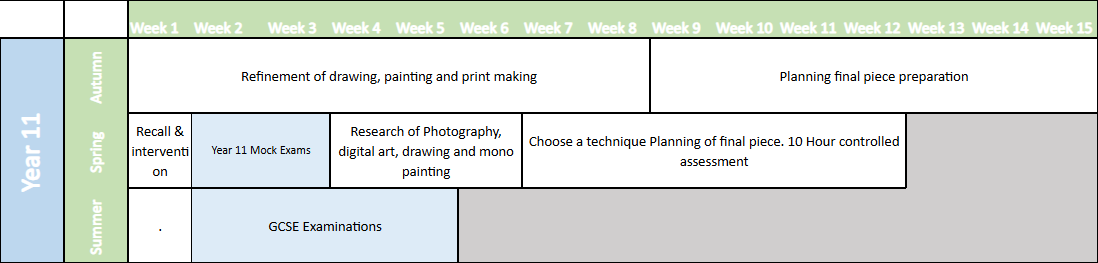
YEAR 11
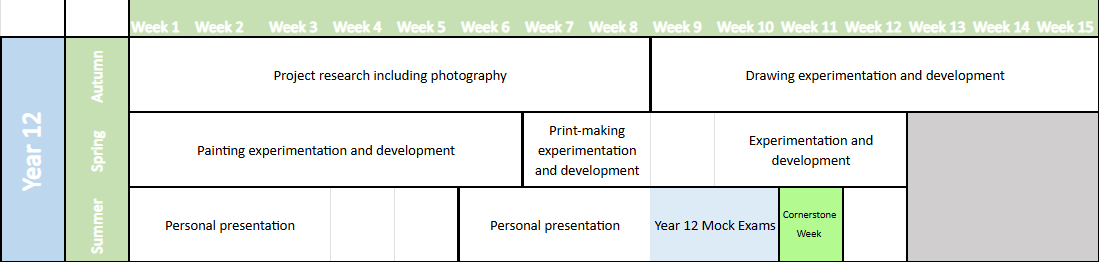
YEAR 12
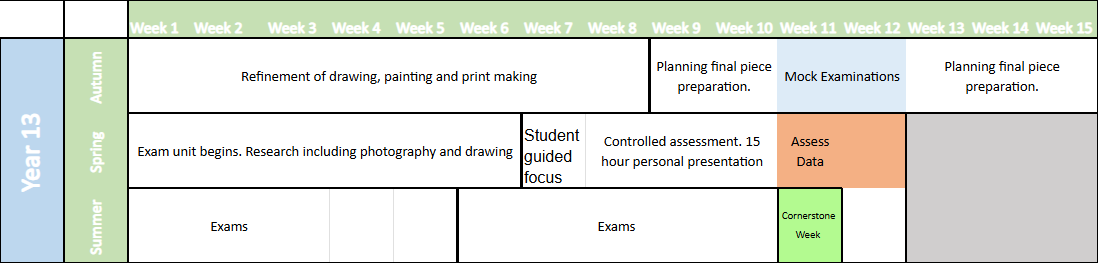
YEAR 13
Further Information
STAFF
The Art Department consists of the following staff:
Mrs R Higham (Head of Department)
Mrs S Kelly
Miss A Goulding
The department has three teachers of Art. All work together extremely well as a team and are very supportive to the Head of Department. Under the direction of the Head of Department members share responsibility for the progress of students throughout Key Stage 3, Key Stage 4 and St Hilda’s College.
ADDITIONAL INFORMATION
At St Hilda’s CE High School Art is shaped by our Christian values and our belief that all students should be given the opportunity to flourish.
We aim to give all pupils opportunities to engage in high quality art experiences. Art is the expression of individual human experience, and we see it as our responsibility to equip young people with the vocabulary, knowledge and practical skills to communicate their view and experiences of the world to others. Our Art Department must inspire and challenge all pupils to create works of Art, Craft and Design that they can be proud of; to approach the process of creation with resilience and curiosity. We aim to build increasingly autonomous learners who experiment with a sense of discovery. We aim to prepare pupils for careers in the ever-growing and changing creative industries and to give them the skills to be good citizens. They will learn of the important role Art and Design has had in shaping our history and how Art is the ideal forum to assimilate information and experiences from other subject areas and life experiences.
Modelling forms a key part of our delivery as we demonstrate each new skill in the classroom, sharing best practice and exemplary work to set high expectations.
It is important to us that our learners develop the skills to function as independent creatives who know how to develop ideas, solve problems, make decisions, be reflective practitioners and create outcomes they are proud of. To this end we carefully scaffold each project to follow a sequence. This scaffold is repeated with increasing depth and challenge as pupils progress throughout KS3, 4 and 5. Our aim is that pupils will take greater ownership of their work, and we gradually move from our roles as leaders and teachers to ultimately become facilitators and critical friends.
We aim to instill in our learners a sense of curiosity about the world around them and a sense of awe and wonder. To notice beauty in their lives and to appreciate the visual communication of another human being.
We celebrate effort and success with displays and rewards postcards.
We maintain an open-door policy where pupils are encouraged to use the art rooms after school to continue with their school artwork or develop their own independent projects.
We seek out opportunities for competitions and display’s outside of school to challenge our learners.
We make creative career pathways an integral part of our curriculum.
The scaffold of our curriculum is based around 6 key areas:
Gathering primary source work.
We use photography and drawing to record observations in the world around us. Pupils are encouraged to be observant, to notice details in their world and gather source work from their own lives to personalize their work. By valuing primary source work over secondary we are encouraging our learners to develop their own ideas and create innovative and original work whose origins lie in their views and observations.
Research and Analysis
Each project will be linked to at least one artist, designer or culture. Research skills are taught in year 7 and built upon with increasing depth and complexity as learners progress throughout. Pupils are given ways to look at artifacts. Their vocabulary is built upon. They are taught to express informed opinions. We value gallery-based learning tasks and include these in our curriculum wherever possible to give pupils a tactile and real time experience of engaging with works of art in an increasingly digital and virtual world. We hope to familiarize young people with galleries and museums, so they feel confident to engage with them outside of their school life and in the future.
Practical skills.
Through observational drawing, we introduce the formal elements as building blocks for creating and talking about art and design when learners join us in year 7. We revisit those throughout the course and formally at the beginning of each year.
Each project will focus on a new skill or technique. Drawing will underpin each project as we revisit the use of the formal elements and refine our skills of observation. Drawing will be used and valued for different purposes. Throughout KS4 and 5 our learners take part in intense skills workshops. Our aim is to equip our learners with a library of skills and techniques which they can draw upon to communicate their ideas visually in a skillful and effective way. Throughout the skills workshops we aim to stretch and challenge our students’ ways of seeing and creating. As students move through the different skills, they will find new strengths and refine existing ones, they form opinions and make judgements.
Reflective Practice.
Using sketchbooks, learners record the ‘story’ of their project from conception to realization. They document their ideas, observations, processes, experiments and discoveries. Learners are encouraged to evidence their mistakes and discuss how they are a step towards their goals. Annotation is used to rigorously share the evolution of each project, decision making along the way and to critically reflect on their own work. Key words and phrases are linked to each project and gradually build learners’ subject specific vocabulary. Using ‘What Went Well’ and ‘Even Better If’, learners are encouraged to be positive about their achievements while always striving for excellence.
Personal Response
Each project is teacher led at the start, echoing starting points at KS4 and 5 and ultimately preparing learners to respond to a brief as a professional. Then, as each project progresses, learners are encouraged to express their own opinions, gather their own observations of the world and create their own personal responses. They are supported to communicate their vision and ideas visually to an audience. Through discussion and annotation learners are encouraged to form opinions and articulate them to others through writing and talking. Learners are given the tools to express their individuality and view of the world.
Presentation
Through the use of modelling and exemplary work we teach learners to organise their work and present it to a high standard. We set high expectations for presentation and encourage pupils to take pride in their work. We maintain that the sketchbook should tell the story of the project and display work should consider the audience.
Regular group critiques throughout each project, build pupils’ confidence to share their work with others and be able to articulate what makes their work successful. Pupils are taught to be supportive of each other and serve as critical friends.
Pupils are given the opportunity to display their work around school to share their achievements.
HOW CAN PARENTS HELP?
Should you wish to help you child with their learning in Art, we would suggest you begin by taking a look at their booklet for the project or the student portal for further helpful hints.
Parents/carers can support their child through providing them with ample space in which to work on their art free from distraction. They can also support them by accompanying them in attending cultural experiences to enhance their understanding of art and the context in which it has been made.
We hope that our parents/carers will take an active interest in their child’s developing projects and will encourage them to discuss the work as it progresses and question the decisions our students have made regarding their art. This will encourage them to develop their ability to annotate and reflect upon their emerging work and thought processes.
WHERE NEXT
As well as giving you the chance to creatively engage with the world around you and develop technical skills, the study of art and design equips you with transferable skills that will support you in both further study and a range of careers.
Alongside the practical expertise you’ll develop in your studies, you’ll also learn transferable skills valued in both higher education and the world of work:
analytical thinking
creative problem solving
working independently
research methods
understanding how context shapes meaning
how to communicate effectively
The analytical and creative problem solving elements of the course will support you in a range of subjects from history, English, business or film studies through to biology, chemistry, physics and Maths.
Art and design also teaches you how to learn from your experiences and work independently – skills valued by employers and higher education institutions alike.