

“Drama awakens the spirit, inviting every student to explore who they are and who they can become.”
Curriculum Vision
Drama at St Hilda’s is shaped by our Christian vision and values, and our belief that all students should be given the opportunity to flourish.
The Drama department at St Hilda’s Church of England High School seeks to empower students through the high-quality teaching of a knowledge-rich and skill focused curriculum. This vision is underpinned by our commitment to creativity, collaboration, and personal expression. We aim to build a culture that nurtures confidence, empathy, and resilience through the exploration of performance, storytelling, and imaginative expression.
Our curriculum is ever-evolving. We continue to reflect, refine, and respond to the needs of our students by researching and implementing best practice. Collaborative planning, evidence-informed pedagogy, and regular evaluation are embedded into our department culture, ensuring our curriculum has a tangible and lasting impact on our students’ personal and academic development.
Curriculum and Assessment Maps
YEAR 7

YEAR 8

YEAR 9

YEAR 10

YEAR 11

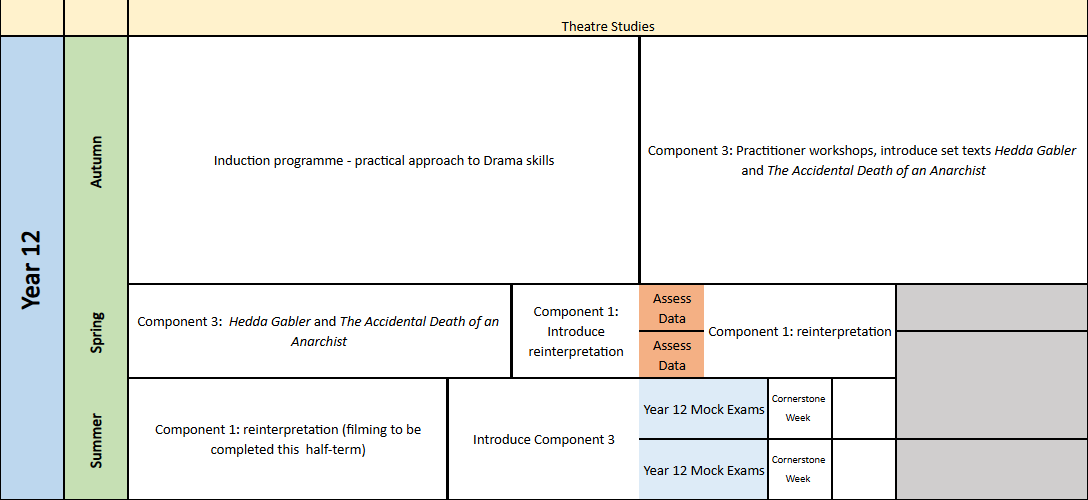
YEAR 12
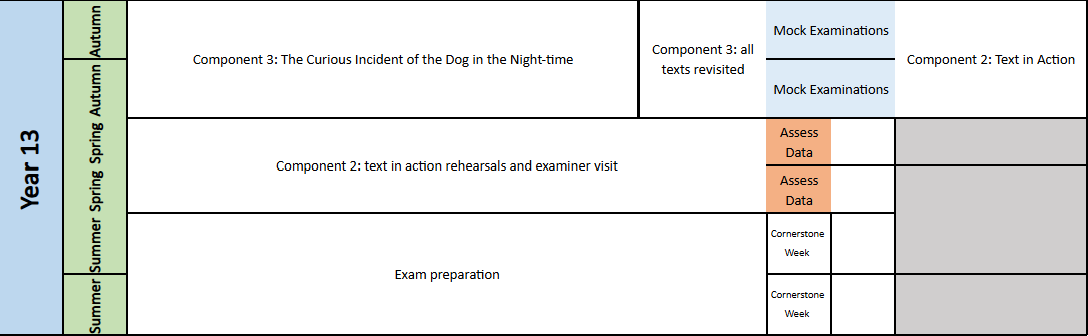
YEAR 13
Further Information
STAFF
The Drama Department consists of the following staff:
The department has two teachers of drama & theatre studies. The team work together extremely well are very supportive to the Head of Department. Under the direction of the Head of Department members share responsibility for the progress of students throughout Key Stage 3, Key Stage 4 and St Hilda’s College.
ADDITIONAL INFORMATION
The purpose of Drama at St Hilda’s is to inspire and equip students with the creative and analytical skills to understand themselves, others, and the world around them. Through the study of dramatic texts, theatre practitioners, performance styles, and devised work. Our purpose is to create a vibrant, supportive environment where all students regardless of their experience feel empowered to explore their voices, tell their stories, and grow as individuals. Whether performing on stage or working behind the scenes, every student has a place in drama.
We seek to:
- Deliver a knowledge-rich and practically engaging curriculum that explores both theory and practical performance.
- Develop confident, articulate communicators who can express themselves with clarity, empathy, and purpose.
- Champion oracy, physical and vocal expression, and collaboration, allowing students to work as individuals and as part of an ensemble.
- Cultivate a deep appreciation of theatre and performance as both an art form and a powerful vehicle for personal growth.
- Encourage critical thinking, reflection, and evaluation skills that enable students to discuss, interpret, and respond to live and scripted performances.
- Provide opportunities for students to explore diverse cultures, perspectives, and voices, fostering tolerance and a wider worldview beyond their local context.
HOW CAN PARENTS HELP?
Allow quiet time and space for learning lines, completing home learning, and other written work.
Double-check that when your child uses a website for research, they are putting the information into their own words. This will help to check they have understood the information, and makes it easier to remember too.
Please avoid making medical appointments when there is an assessed performance coming up – your child will always be working in a group and others will be relying on them in rehearsals.
Encourage your child to read lines with you or a family member at home, by reading in other character’s parts for them. This practice is invaluable when performing scripted plays.
Find a local youth theatre. They are a great way to develop further skills and gain more confidence through performing.
Try to see some live theatre if possible. Look out for last minute offers and student stand-by seats where this applies. As well as the big, well-known theatres in Liverpool, look for smaller local productions by touring professional groups, or repertory theatre groups.
Encourage your child to proof-read written work by asking to look over it yourself, or even better, have them read it to you to help practise their vocal skills!
Come and see your child’s performances whenever possible. It always means a lot for students to have family and friends in the audience, and helps to boost their performance skills as well.
For GCSE students, look out for second-hand copies of plays, or books.
WHERE NEXT
- Design – costume, fashion, 3D design, graphics, set, sound, lighting and projections.
- Community art worker
- Dramatherapist
- Broadcasting, film, TV, radio
- Stage management
- Director
- Arts administration
- Media research
- Teacher
- Prop making
- Make-up artist, and special FX